

By Lorraine Shanley
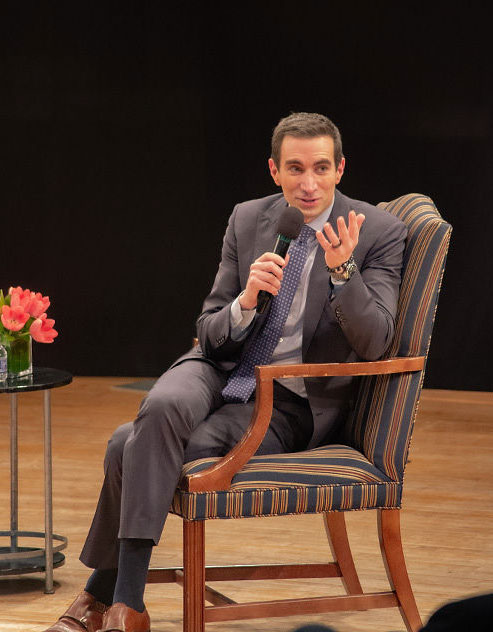
Author of the bestseller 1929, award-winning journalist for The New York Times and a co-anchor of CNBC’s Squawk Box, Andrew Ross Sorkin spoke to a capacity crowd at the annual Brendan Gill Lecture at Sarah Lawrence College on Thursday, February 26. Together with master interviewer David Westin, the anchor of Bloomberg Wall Street Week, Sorkin discussed the lead up to and aftermath of the crash of 1929, the focus of Sorkin’s newest book. The evening’s conversation was a gift to the community from the BHC.
BHC Co-Chair Suzanne Pratt Davis welcomed the audience and noted that this was the 28th presentation of the popular annual event that was named after former Bronxville resident, author and preservationist, Brendan Gill. Davis turned the podium over to Marilynn Hill, co-founder of the BHC, who introduced the speaker, noting Sorkin’s many accomplishments. One highlight was her revelation that Sorkin’s fifth-grade teacher from Scarsdale, Peter Haupt, was in the audience – a surprise that prompted Sorkin to exclaim that “You made such an impression on my whole life.”
Sorkin and Westin discussed the roles of the three presidents whose terms spanned the lead‑up to the 1929 crash and the subsequent Great Depression, with President Herbert Hoover receiving much of the blame for the economic calamity. Sorkin commented that Hoover was in denial “for the longest time. . . .and believed that he, like a lot of politicians including our president today and the previous president, thought that he could jawbone people into believing that things were better than they really were.”
While there are parallels to today’s headlines, such as the role of the Federal Reserve, Sorkin admitted that he hadn’t realized how many overlaps there are between those years when credit was just coming into common use and today, with our national debt as well as the rise of private credit markets. The problem of being over-leveraged is a difficult one in a country where “we are all. . .living beyond our means.” When asked what his conclusion was after spending eight years researching and writing his book, 1929, he said that he believes “Every financial crash is a function ultimately of debt.”
